
PET Needle Punched Geotextile Fabric is often installed where it will never be seen again—beneath gravel, behind drainage layers, under road bases, or below geomembranes. Its performance therefore depends less on appearance and more on whether the material can continue separating, filtering, and protecting different layers after burial.
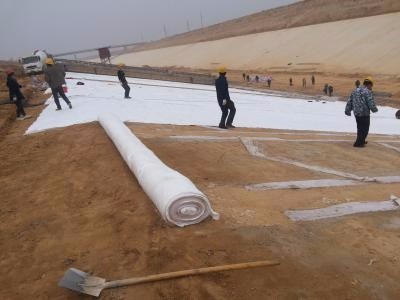
The value of the fabric becomes clearer over time, especially when soil moves, water passes through the structure, and aggregate applies repeated pressure.
What Happens After PET Needle Punched Geotextile Fabric Is Covered?
Once soil or aggregate is placed over the fabric, the material becomes part of the ground structure rather than simply a surface layer.
In a gravel base, aggregate pushes downward while softer soil below may move upward into the spaces between stones. If the two layers mix continuously, the effective gravel layer gradually becomes thinner and less stable.
PET Needle Punched Geotextile Fabric creates a continuous separation layer between these materials. Its fiber structure allows the fabric to adapt to uneven ground while helping keep soil and aggregate in their intended positions.
This is particularly useful in road bases, access roads, parking areas, landscape gravel layers, and other applications where maintaining clear material separation affects long-term stability.
Needle-Punched Structure Helps the Fabric Adapt to Uneven Ground
Real construction surfaces are rarely completely smooth. Soft ground may settle differently from one area to another, while angular stones can create concentrated pressure points.
The needle-punching process mechanically interlocks PET fibers into a three-dimensional network. This structure provides flexibility without turning the material into a closed sheet.
As a result, PET Needle Punched Geotextile Fabric can conform to irregular surfaces while maintaining continuity across the installation area. This characteristic is important where the fabric must tolerate local deformation, installation disturbance, and pressure from overlying aggregate.
The goal is not to keep the geotextile perfectly flat underground. The more important requirement is that it remains intact and continues performing its intended function as surrounding materials move.
Water Movement Changes the Soil Around a Geotextile
Water can gradually move fine soil particles from one layer into another. In drainage systems, this migration may contaminate gravel and reduce the open voids that allow water to flow.
PET Needle Punched Geotextile Fabric provides a porous interface between soil and drainage material. Water can move through the nonwoven structure while the fabric helps limit excessive movement of surrounding soil particles.
This function is important in drainage trenches, retaining wall drainage, landscape drainage, and other structures where water must continue moving without allowing soil to freely enter the aggregate layer.
The fabric does not simply block soil. Its role is to maintain a controlled boundary between materials with very different particle sizes.
Repeated Loading Can Be More Important Than One Heavy Load
Ground structures often change gradually rather than failing suddenly.
A parking area may experience repeated vehicle movement every day. A service road may carry the same loading cycle for years. Each movement can cause small shifts in aggregate and soft subgrade.
Without effective separation, these repeated movements may accelerate mixing between soil and stone. Once fine soil begins entering the aggregate layer, adding more gravel at the surface does not necessarily solve the underlying problem.
PET Needle Punched Geotextile Fabric helps maintain the interface between the two layers so the aggregate can remain more clearly separated from the subgrade over time.
This is one reason buried geotextile performance should be evaluated over repeated use rather than only by how the material looks during installation.
The Same Fabric Structure Can Perform a Different Role Under a Liner
PET Needle Punched Geotextile Fabric is also used where protection is more important than separation.
When placed beneath a geomembrane or pond liner, the fabric forms a cushioning layer between the membrane and rough ground. Stones, uneven soil, or other hard points can create localized pressure that may damage a more vulnerable membrane.
In this situation, the nonwoven fiber structure helps distribute pressure and reduces direct contact between the liner and the substrate.
This function differs from soil separation, even though the same basic type of geotextile may be used. It also explains why fabric thickness and weight may vary according to the role required in the project.
What Can Change Underground Without a Separation Layer?
The effect of geotextile is often easier to understand by looking at the gradual changes that may occur when soil and aggregate remain in direct contact.
|
Underground Change |
Possible Effect |
| Aggregate presses into soft soil | Effective base thickness gradually decreases |
| Fine soil moves upward | Gravel becomes contaminated |
| Water carries fine particles | Drainage spaces become less open |
| Repeated traffic disturbs layers | Soil and aggregate continue mixing |
| Rough ground contacts a liner | Localized membrane damage may occur |
PET Needle Punched Geotextile Fabric does not correct every ground problem, but it helps control the interface where these changes begin.
Installation Continuity Matters as Much as Fabric Coverage
A geotextile can only separate two materials where the layer remains continuous.
If adjacent sections are installed with large gaps or insufficient overlap, soil and aggregate can contact each other directly at those points. The same issue applies beneath liners, where exposed areas may reduce the effectiveness of the protective layer.
For large installations, roll width and roll length therefore become practical considerations. Wider rolls can reduce the number of longitudinal overlaps, while suitable roll lengths can help limit unnecessary joints and cutting.
In narrow drainage trenches or irregular areas, smaller roll dimensions may be easier to handle. The objective is not simply to use the largest roll possible, but to create a continuous layer with manageable installation.
PET Needle Punched Geotextile Fabric for Different Ground Conditions
Different ground conditions place different demands on the same product.
On soft subgrade, the main concern may be maintaining separation between soil and aggregate. In drainage systems, filtration and water movement become more important. Under liners, cushioning and puncture protection move to the foreground.
This means PET Needle Punched Geotextile Fabric should not be treated as one identical solution for every application. Fabric weight, thickness, roll size, and mechanical properties can be adjusted according to the role the material needs to perform.
A useful selection approach begins with the underground condition and the expected function, rather than choosing a fabric only by GSM.
Vinner PET Needle Punched Geotextile Fabric
Vinner provides PET Needle Punched Geotextile Fabric for ground separation, drainage filtration, gravel bases, road construction, landscape applications, and liner protection.
Different configurations are available according to fabric weight, thickness, roll width, roll length, and application requirements. For road and gravel layers, greater attention can be given to mechanical stability and puncture resistance. Drainage applications require suitable permeability and filtration performance, while liner protection may require more cushioning and thickness.
Matching the fabric structure to the condition below the surface helps the geotextile continue performing after installation is complete.
Conclusion
The real performance of PET Needle Punched Geotextile Fabric begins after the material is buried.
Below gravel, it helps maintain separation between aggregate and soil. In drainage systems, it helps control fine-particle migration while allowing water movement. Beneath geomembranes and liners, it provides a protective cushioning layer against rough ground.
Its value is therefore not defined by one visible feature or one specification. What matters is whether the fabric can continue performing its intended role as the surrounding ground, water, and aggregate change over time.
FAQ
1. Why is PET used for needle punched geotextile fabric?
PET fibers can be formed into a stable needle-punched nonwoven structure that combines flexibility, mechanical resistance, and permeability for buried applications.
2. Can PET Needle Punched Geotextile Fabric be used under gravel?
Yes. It is commonly used as a separation layer between aggregate and soil where reducing material mixing is important.
3. Is PET needle punched geotextile suitable for drainage?
It can be used in drainage and filtration applications when its permeability and filtration characteristics are suitable for the surrounding soil and drainage conditions.
4. Can the same PET geotextile be used under a geomembrane?
PET needle punched geotextile can also be used as a protective cushioning layer beneath geomembranes or pond liners, although the required thickness and other properties may differ from separation applications.
Post time: Aug-17-2026