
A Waterproof PVC Garage Mat is most useful when the goal is not simply to cover concrete, but to keep water, snowmelt, mud, road salt, and vehicle drips from spreading across the garage floor. Its value comes from creating a defined parking zone where these contaminants can collect and be cleaned in one place.
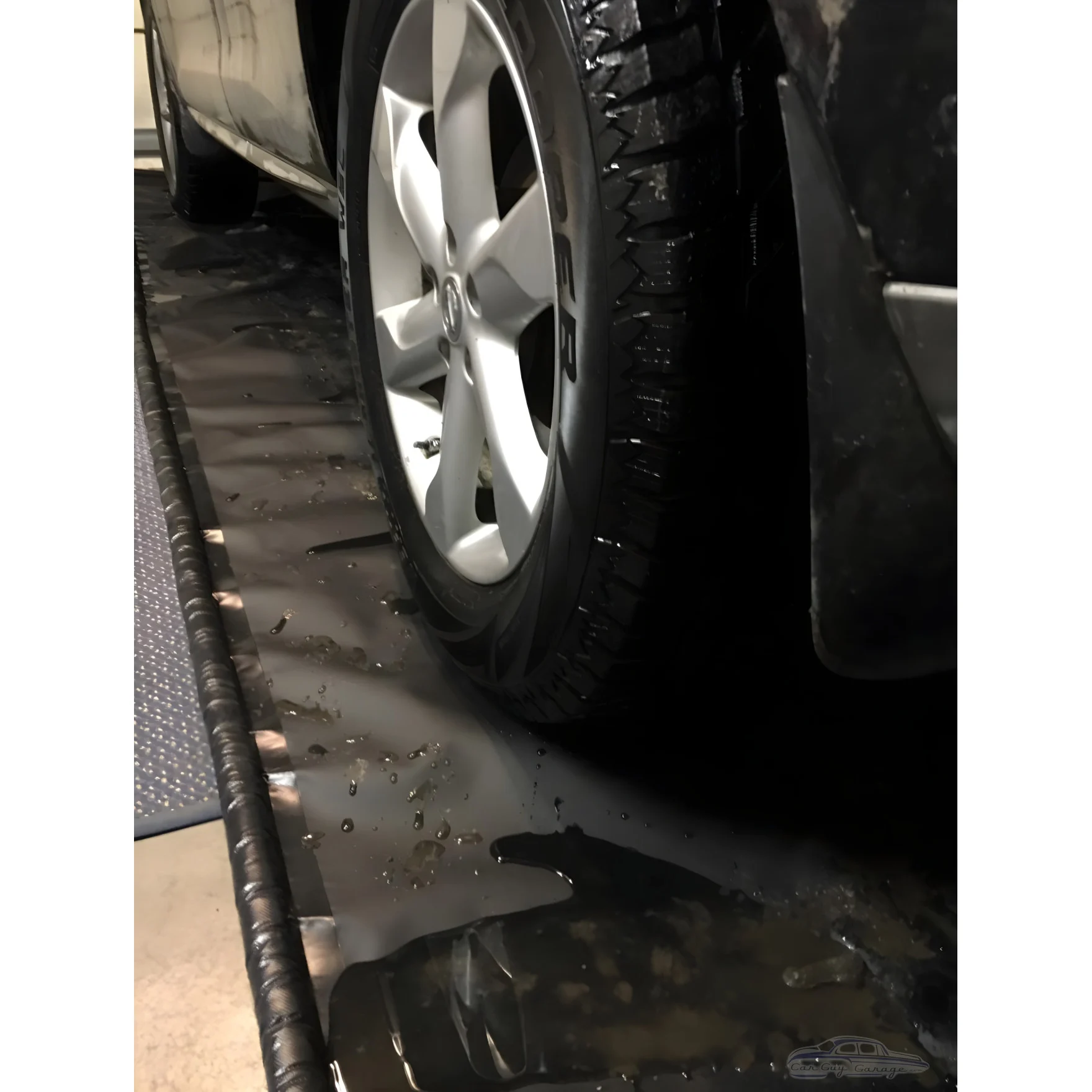
However, a containment mat also has clear operating limits. Understanding those limits is important because many garage-floor problems are caused not by the PVC material itself, but by using the mat for conditions it was never designed to control.
The Main Job Is to Control Movement, Not Absorb Liquid
A waterproof garage mat works differently from carpet, rubber-backed fabric, or absorbent floor pads. PVC does not need to soak up the water. Instead, the waterproof surface keeps moisture above the floor while the raised or sealed perimeter helps prevent it from spreading into surrounding areas.
This becomes especially useful after a vehicle enters the garage during rain or winter weather. Water may continue dripping from wheel wells, tires, underbody panels, and packed snow long after the vehicle has stopped. Mixed with dirt and road salt, that water can travel beyond the parking position and leave a much larger area to clean.
A containment-style Waterproof PVC Garage Mat keeps most of this runoff inside the footprint beneath the vehicle, turning a garage-wide cleaning problem into a defined maintenance area.
Snowmelt Is Usually a Bigger Challenge Than Rainwater
Rainwater brought in on a vehicle is often visible immediately, but snow behaves differently. Snow can remain packed around tires, suspension components, and the underside of the vehicle, then melt slowly over several hours.
That means the amount of liquid on the garage floor can continue increasing after parking.
Snowmelt may also contain:
- Road salt and de-icing chemicals
- Sand and fine gravel
- Mud from roadside slush
- Tire residue
- General road debris
Once the water evaporates, these materials remain on the floor. Road salt is particularly noticeable because it can leave white deposits that spread beyond the original wet area.
A waterproof PVC mat does not remove these contaminants, but it can limit how far they travel. This makes later sweeping, mopping, or rinsing much more manageable.
A Garage Mat Cannot Compensate for Insufficient Coverage
One of the most practical limitations is size.
A waterproof material can only contain runoff that actually lands inside the mat. If the front bumper, rear of the vehicle, or wheel areas extend beyond its coverage, water and slush may still reach the concrete.
The useful mat area therefore needs to reflect the complete parked footprint, not simply the dimensions between the four tires.
This matters particularly for pickups, SUVs, and vans. Their wheelbase may fit comfortably within a smaller mat while the vehicle body extends much farther forward or backward. Snow and water dripping from those overhangs can fall outside the containment area.
A suitable mat should provide reasonable clearance around the vehicle while still leaving access to garage doors, steps, cabinets, drains, and walking areas.
What Should a Waterproof PVC Garage Mat Normally Handle?
For everyday garage use, a containment mat is well suited to common vehicle-related moisture and debris.
|
Garage Contaminant |
How the Mat Helps |
| Rainwater | Keeps dripping water within the parking area |
| Melting snow and ice | Contains gradual runoff beneath the vehicle |
| Slush | Limits the spread of water, mud, and road debris |
| Road salt | Helps keep salt-contaminated water in one zone |
| Mud and sand | Creates a defined area for later cleaning |
| Minor vehicle drips | Prevents small amounts of fluid from spreading directly over the floor |
| Dust and tire debris | Makes loose contamination easier to collect |
The important word here is containment. The mat creates a controlled surface, but the collected material still needs to be removed periodically.
What Should Not Be Expected from a Garage Containment Mat?
Knowing what the product cannot do is just as useful.
A garage mat should not be treated as a substitute for a permanent drainage system where large volumes of water are continuously entering the garage. If water regularly floods through the door or enters from walls and foundations, the source of the water needs to be addressed separately.
It also should not be considered a solution for uncontrolled industrial chemical spills or large mechanical leaks. Compatibility depends on the liquid involved, exposure time, temperature, and PVC formulation. Routine vehicle drips and winter runoff are very different from repeated exposure to aggressive chemicals.
Likewise, the mat cannot correct an extremely uneven floor. Significant slopes, deep cracks, raised joints, or sharp projections can affect how the PVC sits and where collected water moves.
The product works best when it is used for the problem it is designed to solve: containing everyday vehicle runoff and debris within a manageable parking area.
Cleaning Frequency Depends on What the Vehicle Brings In
A garage containment mat does not need the same cleaning schedule in every environment.
During dry seasons, loose dust and small debris may only require occasional sweeping. During rainy periods, standing water may need to be removed more frequently. Winter conditions usually require the most attention because melting snow leaves behind a concentrated mixture of salt, dirt, and grit.
The mat can typically be maintained by sweeping, mopping, or moving it outside for rinsing when conditions allow. Removing accumulated debris is important because dried grit can be carried back onto tires and spread around the garage.
Regular cleaning also makes it easier to inspect the mat surface and perimeter for damage.
PVC Is Useful Because the Surface Can Be Reused
The advantage of PVC in this application is not simply that it is waterproof. A heavy-duty PVC surface can be repeatedly exposed to wet tires, dirty footwear, snowmelt, and routine garage debris, then cleaned and used again.
Unlike disposable absorbent materials, the purpose is to create a reusable containment zone.
For this reason, practical product performance depends on several characteristics working together: waterproof construction, reliable edge sealing, resistance to repeated vehicle movement, a surface that can be cleaned, and enough flexibility to unfold and sit properly on the garage floor.
Vinner Waterproof PVC Garage Mat
Vinner provides heavy-duty Waterproof PVC Garage Mat options designed for rainwater, melting snow, slush, mud, road salt, dust, road debris, and minor vehicle drips.
Custom dimensions are also available for different vehicles and garage layouts.
The mat uses high-strength PVC with sealed edges, an improved material structure designed to reduce wrinkling, and an anti-slip corner design that helps maintain position during use. No assembly is required; the mat can be unfolded and placed with the smooth side facing down.
The Most Useful Garage Mat Is One Used for the Right Problem
A waterproof garage mat is not meant to solve every water or floor problem inside a garage. Its strength is much more specific: controlling the everyday mess that follows a vehicle indoors.
When the mat is correctly sized and used on a suitable floor, it can keep snowmelt, rainwater, mud, road salt, and small drips concentrated beneath the vehicle instead of allowing them to spread across the garage.
That narrower purpose is exactly what makes a Waterproof PVC Garage Mat useful. It does not eliminate dirt or water; it makes both easier to control.
FAQ
Can a Waterproof PVC Garage Mat hold melting snow overnight?
Yes, when the volume is within the mat’s containment capacity and the runoff remains inside the perimeter. Heavy snow accumulation should still be monitored and removed as needed.
Can the mat be used for an SUV or pickup truck?
Yes, but the mat should cover the complete vehicle footprint, including front and rear overhangs rather than only the wheelbase.
Does a waterproof garage mat absorb water?
No. A PVC containment mat is designed to keep liquid on its waterproof surface and within its perimeter so the liquid can later be removed.
Can the mat replace a garage drain?
No. It is intended to contain normal vehicle runoff and debris, not replace drainage where large or continuous volumes of water enter the space.
Post time: Aug-21-2026