
Learn how to choose the right garage floor mat size based on vehicle dimensions, garage space, weather conditions, and everyday use. Compare common sizes for cars, SUVs, pickup trucks, vans, and commercial vehicles.
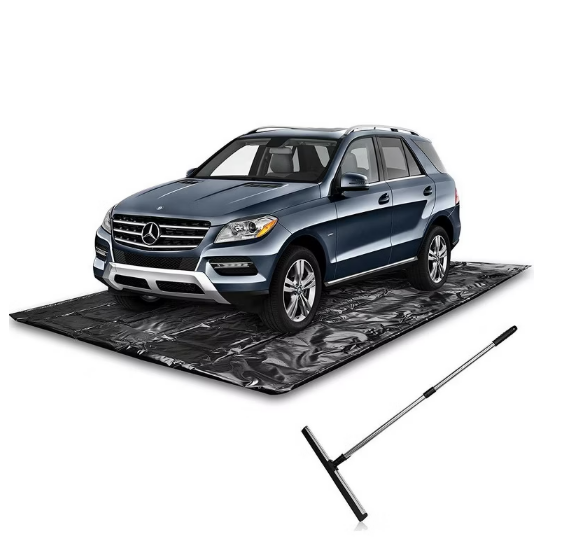
A suitable garage floor mat should fully cover the areas where water, snow, and dirt are most likely to fall while still fitting the actual garage layout. Its waterproof performance, stability, ease of cleaning, and durability also affect how well the selected size performs in daily use.
Why Should a Garage Floor Mat Extend Beyond the Four Tires?
Choosing a mat based only on tire position is a common sizing mistake.
Water and dirt do not remain directly beneath the tires after a vehicle is parked. For example:
- Snow may fall from the front and rear bumpers.
- Rainwater may drip from the doors and side panels.
- Mud often collects around the wheel arches and underbody.
- Road salt may spread with melting snow.
- Minor vehicle drips may appear beneath the engine or chassis.
For these reasons, a garage floor mat should generally be wider and longer than the vehicle’s exact footprint.
Leaving reasonable space around the front, rear, and sides creates a more complete containment area. Even when the vehicle is not parked in exactly the same position every day, water and dirt are less likely to fall outside the mat.
What Size Garage Floor Mat Is Suitable for Different Vehicle Types?
A garage floor mat should cover the areas around the front, rear, and sides of the vehicle where water, snow, mud, and debris are likely to fall, rather than only covering the four tires. The following sizes can be used as an initial reference:
|
Vehicle Type |
Recommended Size |
Suitable Use |
| Compact and midsize cars | 7 ft 9 in × 16 ft | Suitable for standard residential garages and provides adequate coverage for many passenger cars |
| Longer sedans, small crossovers, and small SUVs | 7 ft 9 in × 18 ft | Provides additional front and rear coverage, especially when parking positions vary slightly or the vehicle is frequently exposed to rain and snow |
| Full-size SUVs, standard pickup trucks, and standard vans | 8 ft 6 in × 20 ft | The wider surface covers larger tires, wheel arches, side steps, and both sides of the vehicle |
| Long-bed pickup trucks, extended vans, and some commercial vehicles | 8 ft 6 in × 22 ft | Suitable for longer vehicles, large rear overhangs, or vehicles with fixed towing attachments |
| Special vehicles or irregular garage layouts | Custom size | Dimensions can be adjusted according to the vehicle, parking position, and available floor space |
Several additional factors should also be considered:
- For cars, pay particular attention to length. Leave enough space at the front and rear to collect drips from the bumpers, engine area, and trunk area.
- For SUVs, width is especially important. Larger tires, wider wheel arches, and side steps increase the area where rainwater, mud, and snow may fall.
- Pickup trucks should be measured from end to end. Include the cab, truck bed, front and rear bumpers, and any fixed towing attachments.
- Vans and commercial vehicles vary considerably. Differences in wheelbase, rear overhang, and body structure may require a longer or customized mat.
Regardless of the vehicle type, the mat should cover the complete vehicle and leave reasonable space around the front, rear, and sides. This helps prevent rainwater, mud, melting snow, and road debris from falling outside the protected area.
Finding the Right Balance Between Mat Size and Garage Space
A garage floor mat should provide enough coverage around the vehicle without interfering with the normal use of the garage. Both undersized and oversized mats can create practical problems.
If the Mat Is Too Small
An undersized mat may leave important areas outside the protected surface. This can result in:
- Front or rear bumpers extending beyond the mat
- Melting snow and rainwater reaching the concrete floor
- Mud falling outside the mat near the wheel arches
- Vehicle drips landing on uncovered areas
- More precise parking being required every day
- Continued cleaning around the mat edges
Even a small change in parking position may allow water and dirt to fall outside the protected area.
If the Mat Is Too Large
A larger mat provides more coverage, but excessive size may affect the garage layout. It may:
- Block storage cabinets or work areas
- Cover a garage floor drain
- Extend into doors, stairs, or walkways
- Reduce the available space around the vehicle
- Wrinkle where it touches walls or fixed objects
- Be more difficult to remove, rinse, and dry
The Best Size
The most practical garage floor mat should cover the full vehicle and leave reasonable space around the front, rear, and sides. At the same time, it should preserve access to storage areas, drains, doors, walkways, and other garage functions.
What Product Details Matter Besides Size?
Size determines the coverage area, but material and structural details also affect daily performance.
Waterproof PVC Surface
High-strength PVC creates a continuous waterproof surface for containing rainwater, melting snow, mud, dust, road salt, and minor vehicle drips.
Before driving onto the mat, remove sharp stones, screws, and metal fragments from the garage floor and tire treads. Concentrated pressure from sharp objects may damage flexible materials.
Material Designed to Reduce Wrinkles
Garage floor mats are often folded during transportation and storage. Improved material construction helps reduce deep wrinkles and allows the mat to return to a flatter condition after unfolding.
A flatter surface improves parking stability and makes sweeping and rinsing easier.
Edge Sealing
The edges should maintain reliable sealing to reduce the risk of water escaping around the perimeter. During installation, check that the corners and edges are not severely curled or folded.
Anti-Slip Corner Design
Anti-slip corners help reduce movement when the vehicle repeatedly enters and exits. Aligning the mat with the normal parking direction also reduces repeated tire contact with its outer edges.
How Should Different Garage Mat Sizes Be Cleaned?
A larger mat offers more complete coverage, but it also requires more open space during cleaning.
Dry dust, sand, and mud can be removed with a broom. When the mat contains heavier mud or road salt, move the vehicle and pull the mat into a suitable position for rinsing with a hose.
After cleaning, allow the surface to dry while unfolded. Avoid folding and storing the product while water, mud, or cleaning residue remains on the surface.
When choosing a size, consider not only the parked vehicle but also whether there is enough space around the garage to sweep, rinse, and dry the mat.
Vinner Garage Floor Mat Sizes and Product Options
Vinner provides heavy-duty waterproof garage floor mats for cars, SUVs, pickup trucks, vans, and larger commercial vehicles.
The mats are made from high-strength PVC and can contain rainwater, snow, melting ice, mud, dust, road debris, and vehicle drips. The upgraded material is designed to improve daily durability, reduce wrinkles, and support better edge sealing.
No complicated assembly is required. The mat can be used after it is unfolded and positioned with the smooth side facing downward. Anti-slip corner construction helps keep the mat stable and reduces the need for frequent repositioning.
Available sizes include:
- 7 ft 9 in × 16 ft
- 7 ft 9 in × 18 ft
- 8 ft 6 in × 20 ft
- 8 ft 6 in × 22 ft
- Custom sizes available
These options support different vehicles and garage layouts. Dimensions can also be adjusted for special vehicles, commercial parking areas, and nonstandard floor spaces.
Conclusion
Choosing the right garage floor mat size involves more than determining whether the vehicle can physically fit on the surface.
The mat should cover the tires, wheel arches, engine area, bumpers, and other locations where water, snow, mud, and vehicle drips commonly fall. At the same time, it should not interfere with the garage door, storage cabinets, workbench, or walking areas.
Once the size is correctly matched, a high-strength PVC surface, anti-slip corners, reduced wrinkling, and reliable edge sealing can further improve the mat’s daily performance and maintenance.
FAQ
1. How much larger should a garage floor mat be than the vehicle?
The mat should leave additional space around the front, rear, and sides to contain rainwater, melting snow, mud, and drips from the bumpers, wheel arches, doors, and underbody. The exact allowance depends on the vehicle dimensions and available garage space.
2. What vehicles are suitable for a 7 ft 9 in × 16 ft garage mat?
This size is commonly suitable for compact and midsize cars. The full vehicle length should still be measured to confirm that enough space remains around the front and rear.
3. Do SUVs and pickup trucks need a wider garage floor mat?
In many cases, yes. SUVs and pickups generally have wider bodies, tires, and wheel arches. An 8 ft 6 in wide mat can provide more complete side coverage.
4. What if the standard sizes do not fit the garage?
The dimensions can be adjusted according to the vehicle length, width, parking position, and the location of permanent garage structures, allowing the mat to fit the actual floor area more accurately.
Post time: Aug-03-2026