
A Garage Containment Mat is designed to create a defined protective area beneath a parked vehicle. Its job is not simply to cover concrete. It needs to keep melting snow, rainwater, slush, mud, road salt, debris, and minor vehicle drips from spreading across the garage floor.
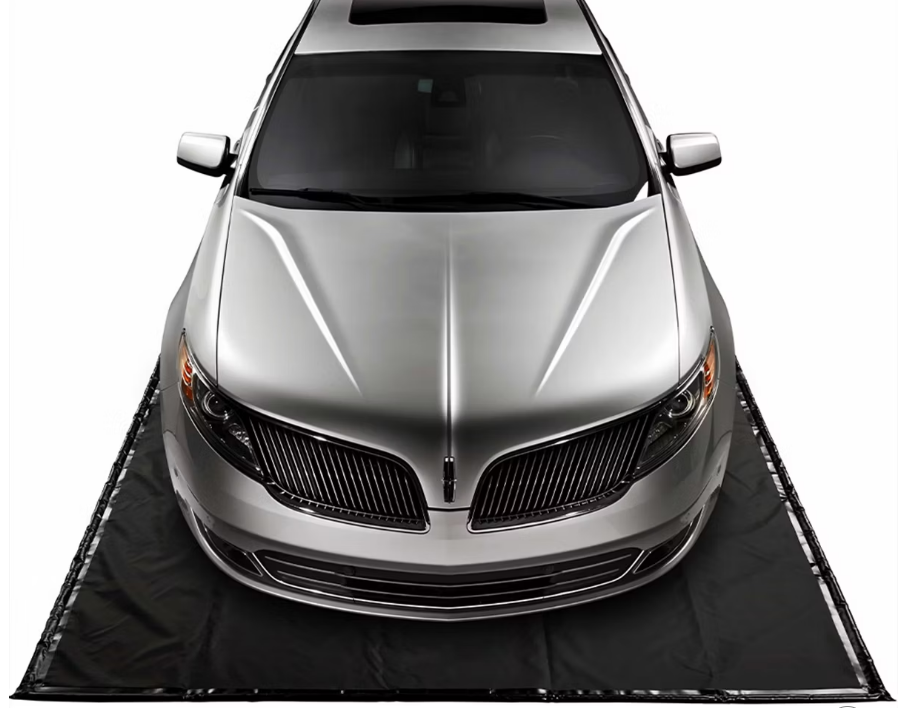
That performance depends on several details working together: the waterproof surface, edge construction, material stability, floor contact, and sufficient coverage around the vehicle.
Garage Containment Mat:Containment Is Different from Simple Floor Coverage
A flat floor covering protects only the area directly underneath it. A containment mat needs to do more.
When a wet or snow-covered vehicle enters the garage, water does not always drip straight down. It may run along tires, wheel arches, bumpers, side panels, and underbody components before reaching the floor.
Melting snow can also continue releasing water for a long period after the vehicle is parked.
A practical garage containment surface therefore needs to:
- Hold liquid within its covered area
- Prevent water from passing through the material
- Reduce uncontrolled spreading across concrete
- Remain stable beneath the vehicle
- Handle repeated wet and dry conditions
- Support routine cleaning without complicated installation
This is why the material and construction of the mat matter as much as its overall dimensions.
Waterproof PVC Creates the Main Protective Surface
The core of a garage containment mat is its waterproof layer.
Vinner garage containment mats use high-strength PVC, providing a continuous barrier between the vehicle and the garage floor. Instead of allowing melted snow, muddy water, or vehicle drips to reach the concrete immediately, the liquid remains on the mat where it can be managed later.
PVC is particularly practical for garage use because the surface needs to cope with more than water.
Typical garage contaminants include:
- Rainwater
- Melting snow and ice
- Slush
- Mud
- Dust
- Road debris
- Road salt
- Minor vehicle drips
The material also needs enough durability for tires to repeatedly roll onto and off the same area.
A containment mat that is waterproof but easily damaged will lose much of its value once the surface develops tears or weak points. Material strength and waterproof performance therefore need to work together.
Edge Sealing Is Critical to Containment Performance
The center of the mat may be completely waterproof, but liquid can still escape if the perimeter does not perform properly.
This makes edge construction one of the most important parts of a Garage Containment Mat.
The perimeter helps define the area where water, mud, and melting snow are retained. Weak edge sealing may allow moisture to migrate beyond the mat or cause the perimeter to become less stable after repeated use.
Improved edge construction provides several practical benefits:
- Helps keep collected moisture within the mat area
- Reduces weak points around the perimeter
- Supports repeated vehicle entry and exit
- Helps maintain the overall shape of the mat
- Improves durability during cleaning and handling
For a product intended to contain liquids, the perimeter should be considered part of the functional structure rather than a finishing detail.
Why Wrinkle Control Matters More Than Appearance
Wrinkles may look like a cosmetic issue, but on a garage floor they can affect how the mat performs.
Severe folds or raised areas may:
- Interfere with tire movement
- Create uneven collection areas
- Make sweeping or rinsing more difficult
- Allow dirt to collect along folded sections
- Prevent parts of the mat from sitting flat on the floor
A more stable PVC material helps reduce excessive wrinkling after the mat is unfolded and placed in position.
Vinner’s updated Garage Containment Mat design uses improved material intended to provide greater durability and fewer wrinkles.
The goal is not to make the surface perfectly rigid. A garage mat still needs flexibility for handling and storage. The more important requirement is achieving a practical balance between flexibility and dimensional stability.
Floor Contact Helps the Mat Stay Where It Belongs
Every time a vehicle enters or leaves the garage, the tires create forces against the mat.
If the corners lift or the surface shifts repeatedly, maintaining a consistent protected area becomes more difficult.
For this reason, Vinner’s Garage Containment Mat includes an anti-slip corner design to help maintain its position during normal use.
The mat is installed with the smooth side facing down. No frame assembly or complex construction is required; it can simply be unfolded and positioned on the prepared garage floor.
Stable floor contact is especially useful when:
- A vehicle enters the garage every day
- Tires are wet or covered with snow
- The mat is cleaned regularly
- Larger vehicles place more load on the surface
A containment mat should remain practical during everyday vehicle movement, not only when it is first placed on the floor.
The Mat Has to Handle Repeated Seasonal Changes
Garage conditions can change significantly throughout the year.
In summer, the main concern may be rainwater, dust, and minor vehicle drips. During winter, one parked vehicle can carry snow, ice, road salt, and slush into the garage.
The amount of moisture may also change considerably from day to day.
This means a containment mat is repeatedly exposed to:
Wet conditions → drying → vehicle loading → dirt accumulation → cleaning → reuse
The material needs to tolerate this cycle without becoming difficult to handle.
A high-strength PVC construction is well suited to this type of repeated use because it provides waterproof protection while remaining flexible enough for normal cleaning and repositioning.
A Garage Containment Mat Also Simplifies Where the Mess Goes
One overlooked advantage of a containment mat is that it creates a predictable maintenance zone.
Without a defined surface, water and dirt can spread under shelves, beside walls, around stored items, or across walking areas.
With a properly positioned mat, most contamination from the vehicle is concentrated within one controlled section of the garage.
That changes the cleaning process.
Instead of repeatedly cleaning a larger concrete floor, the mat can be:
- Swept to remove dry debris
- Mopped for routine cleaning
- Pulled outside when necessary
- Rinsed with water
- Allowed to dry before being returned to position
This is particularly useful in garages where vehicles regularly bring in snow, mud, or road debris.
What Should a Reliable Garage Containment Mat Provide?
Instead of judging a mat only by size or appearance, several performance details should be considered together.
Waterproof Surface
The material should prevent water, slush, and minor drips from passing directly through to the concrete.
Durable Material
The surface needs to handle repeated tire contact and daily garage use.
Stable Edge Construction
The perimeter should help maintain the containment area and resist premature weakening.
Reduced Wrinkling
A flatter surface improves vehicle access, maintenance, and general usability.
Stable Positioning
The mat should remain reasonably secure rather than moving every time the vehicle enters.
Easy Maintenance
Routine dirt and water should be manageable without complicated disassembly.
A useful Garage Containment Mat combines these features as one system rather than relying on one single specification.
Vinner Garage Containment Mat
Vinner provides heavy-duty Garage Containment Mats made from high-strength waterproof PVC for residential garages and larger vehicle applications.
The mats are designed for vehicles that regularly bring rainwater, snow, ice, slush, mud, road debris, and other contaminants into the garage.
Different dimensions also make it possible to match the protective area to passenger cars, SUVs, pickup trucks, vans, and larger commercial vehicles.
Conclusion
The effectiveness of a Garage Containment Mat depends on more than placing a waterproof sheet beneath a vehicle.
Real containment comes from the combination of waterproof PVC, reliable edge construction, reduced wrinkling, stable floor contact, suitable dimensions, and durability under repeated vehicle use.
When these details work together, the mat creates a defined zone for rainwater, melting snow, mud, debris, and minor vehicle drips, helping prevent them from spreading throughout the garage.
For daily use, the most practical Garage Containment Mat is one that remains simple: unfold it, position it correctly, park the vehicle, and clean the contained area when needed.
FAQ
1. What is the main purpose of a Garage Containment Mat?
It creates a waterproof area beneath a vehicle to help contain rainwater, melting snow, slush, mud, road debris, and minor vehicle drips.
2. Why is edge construction important on a containment mat?
The edges help define and maintain the protected area. Stronger edge sealing reduces weak points where collected moisture could escape or the mat could deteriorate.
3. Why should a Garage Containment Mat stay relatively flat?
A flatter mat is easier to drive over, clean, and maintain. Reduced wrinkling also helps prevent dirt and water from concentrating in unwanted folds.
Post time: Aug-10-2026