
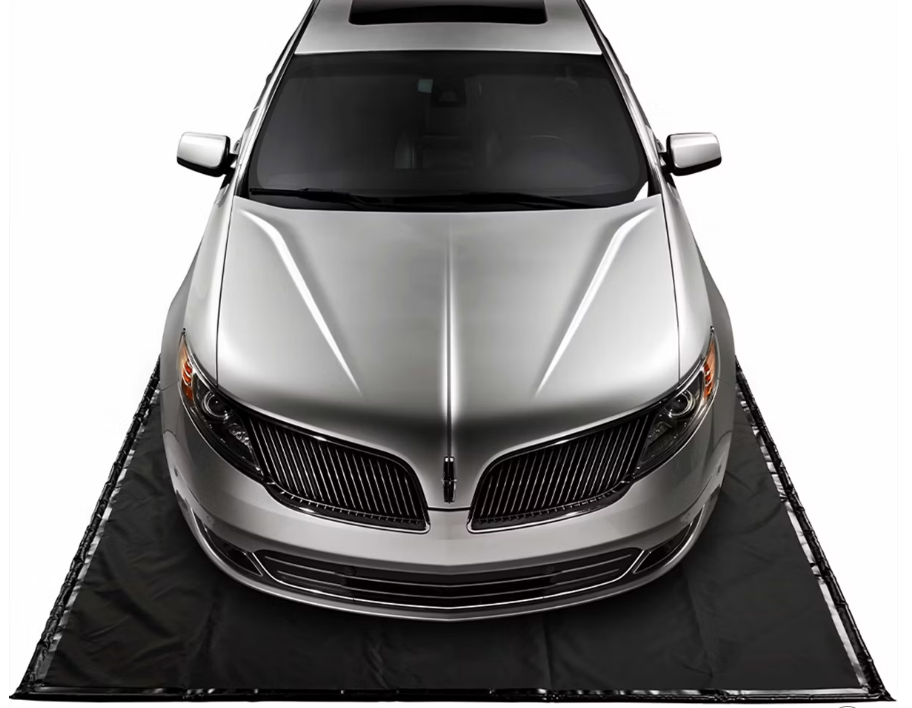
A Car Wash Mat for mobile detailing does more than provide a waterproof surface under a vehicle. When washing and detailing are performed in driveways, parking areas, commercial lots, or temporary workspaces, the wash area needs to handle water, dirt, cleaning products, and repeated vehicle movement without turning the surrounding surface into another problem to manage.
For mobile detailing businesses, this becomes especially important because the working environment changes from job to job. A suitable mat can create a defined wash area while making it easier to control where water and debris go.
Why Mobile Detailing Creates a Different Ground Protection Challenge
A fixed car wash bay is designed around drainage, cleaning, and vehicle movement. Mobile detailing does not have that advantage. The same operator may work on a concrete driveway in the morning, a paved parking area in the afternoon, and another residential property the next day.
During washing, water quickly mixes with road dirt, mud, dust, shampoo, and other residues on the vehicle. Without a defined working surface, this mixture can spread across a much larger area than expected. It can also make the surrounding ground wet and slippery, while repeated washing gradually leaves the work area looking dirty.
This is why a mobile detailing setup needs to consider the ground underneath the vehicle as part of the working area, rather than treating it as an afterthought.
A Car Wash Mat Helps Define the Working Area
One practical advantage of a Car Wash Mat is that it creates a clear boundary around the vehicle.
Instead of allowing wash water to spread naturally across the driveway or parking surface, the mat provides a controlled area for the washing operation. This is useful when the detailing service is performed in locations where the surrounding surface needs to remain relatively clean.
The defined area can also make the work process more organized. Hoses, cleaning equipment, buckets, and other tools can be positioned around a consistent working zone rather than adapting to the ground conditions at every new location.
For mobile detailing companies, that consistency can be valuable because the equipment may need to be packed, transported, and set up repeatedly throughout the week.
Water Is Only Part of What the Mat Needs to Handle
Water is usually the most obvious concern, but it is not the only material reaching the ground.
A vehicle can carry fine sand, mud, road dust, oil residue, salt, and other contaminants into the wash area. Once water is introduced, these materials move across the surface much more easily.
The mat therefore needs more than simple waterproofing. Its surface should be suitable for repeated wet conditions, while the overall construction needs to remain stable as people walk around the vehicle and the vehicle itself moves on and off the mat.
This is particularly relevant for mobile detailing because the mat may be used frequently and transported between locations. A product that works well for occasional home washing may face very different demands when it becomes part of a professional detailing setup.
The Size Should Follow the Actual Detailing Process
Choosing a Car Wash Mat only by vehicle length can create problems.
The vehicle itself is not the entire working area. Detailers need space around the sides for washing, rinsing, drying, wheels, tires, and other operations. Water can also travel beyond the vehicle footprint during spraying.
For this reason, the useful coverage area should be considered together with the way the detailing service is performed. A compact mat may be sufficient for a limited washing area, while larger vehicles or more comprehensive detailing operations may require additional coverage.
The right size is therefore less about finding the largest possible mat and more about creating enough usable space around the vehicle without making transportation and setup unnecessarily difficult.
Surface Durability Matters During Repeated Use
A mobile detailing mat is exposed to more than water.
Vehicle tires repeatedly pass over the surface. Operators walk across it while carrying equipment, and the mat may be folded or rolled for transportation between jobs. Sand and small particles can also create additional abrasion when the surface is being used.
This makes surface durability an important consideration for professional applications.
PVC is commonly used for this type of product because it can provide a waterproof surface while also offering the flexibility needed for handling and storage. The actual performance, however, depends on the material construction, thickness, reinforcement, surface design, and how the mat is used.
For a professional detailing operation, these characteristics should be considered together rather than judging a mat only by its appearance.
A Portable Wash Area Can Make Mobile Detailing More Consistent
One of the main advantages of using a Car Wash Mat in mobile detailing is repeatability.
The working environment may change, but the basic wash area can remain relatively consistent. The operator can bring the mat to the next location, position it under the vehicle, complete the washing process, and then roll or fold it for transport.
This makes the mat different from permanent drainage or flooring solutions. It does not require the detailing business to modify every location where a vehicle is serviced.
For operators working across residential properties, commercial parking areas, dealerships, or temporary detailing locations, that flexibility can be particularly useful.
What Should You Consider When Choosing a Car Wash Mat?
The most useful specifications depend on how the mat will actually be used. For mobile detailing, several factors deserve attention:
- Material: PVC is suitable for applications requiring waterproofing and flexible handling.
- Size: Consider the vehicle footprint as well as the working space required around it.
- Construction: Reinforced construction can be important for repeated handling and vehicle traffic.
- Surface: The surface should balance traction, durability, and ease of cleaning.
- Edge structure: A suitable edge design can help keep water within the intended working area.
- Portability: The mat should be practical to roll, transport, store, and deploy repeatedly.
The important point is that these specifications work together. A very large mat is not automatically more practical, and a very heavy construction is not necessarily the best choice for a mobile operation.
Car Wash Mat Applications Beyond Mobile Detailing
Although mobile detailing is a strong application, the same type of mat can also be useful wherever washing creates a temporary wet work area.
Home vehicle washing, automotive service locations, dealerships, detailing studios, fleet maintenance areas, and temporary wash stations may all benefit from a waterproof surface that can be deployed without permanent floor construction.
The required material, dimensions, and construction can vary depending on vehicle type, washing frequency, working environment, and transportation requirements.
Choosing the Right Car Wash Mat for Your Application
For mobile detailing, the best configuration starts with the working environment rather than a standard product specification.
A small detailing operation working mainly with passenger cars may prioritize portability and quick setup. A professional service handling SUVs, pickups, or multiple vehicles may place greater emphasis on coverage, durability, and repeated vehicle traffic.
This is also where product customization can become useful. Different detailing operations may require different dimensions, material constructions, surface treatments, or packaging formats.
Vinner provides PVC-based Car Wash Mat solutions for applications including mobile detailing and vehicle washing. With manufacturing and customization capabilities, the product can be developed around different size, material, and application requirements instead of relying on a single fixed configuration.
Conclusion
A Car Wash Mat for mobile detailing should be considered part of the detailing workspace, not simply a waterproof sheet placed under a vehicle. It needs to accommodate water, dirt, vehicle traffic, operator movement, repeated handling, and the practical demands of working in different locations.
For mobile detailing businesses, a well-designed mat can help create a more controlled and repeatable wash area while remaining flexible enough to transport between jobs. The right choice ultimately depends on the vehicle types, wash process, frequency of use, available space, and portability requirements.
FAQ
1. What is a Car Wash Mat used for?
A Car Wash Mat provides a waterproof working surface underneath and around a vehicle during washing or detailing. It helps define the wash area and reduce the spread of water, dirt, mud, and cleaning residues onto the surrounding ground.
2. Is a Car Wash Mat suitable for mobile detailing?
Yes. A Car Wash Mat can be particularly useful for mobile detailing because it can be transported between locations, quickly deployed, and removed after the job. The appropriate size and construction depend on the vehicles being serviced and the space required for the detailing process.
3. What material is commonly used for Car Wash Mats?
PVC is commonly used because it combines waterproofing with flexibility and can be manufactured in different thicknesses, sizes, and constructions. For frequent professional use, factors such as reinforcement, surface durability, edge construction, and overall material structure should also be considered.
4. Can Car Wash Mats be customized for different vehicles?
Yes. Car Wash Mats can be produced in different dimensions and configurations to accommodate passenger cars, SUVs, pickups, and other vehicles. Customization can also cover material construction, surface treatment, edge design, and packaging depending on the intended application.
Post time: Sep-28-2026